Sustainability is no longer a peripheral marketing tactic; it is the core of modern food retail strategy. Leading supermarkets now lean heavily on public ESG (Environmental, Social, and Governance) reporting, broadcasting ambitious targets for resource management and carbon neutrality.
However, a critical disconnect persists. While the storefront promotes "Green" initiatives, the back-of-house hygiene operations often remain stuck in a high-waste, conventional cycle. This Operational Greenwashing—promoting sustainability while practicing outdated sanitation—creates significant reputational and financial risk.
To align corporate promises with store-level reality, retailers must address four critical "sustainability leaks" in their daily cleaning practices:
Without precision dilution control systems, professional cleaning becomes a game of guesswork. Excessive chemical usage does more than inflate monthly procurement costs; it leads to chemical surfactant buildup on high-touch surfaces. This residue degrades floor aesthetics and, ironically, compromises the very food safety standards the marketing department promises.
A major threat to retail hygiene integrity is the "shelf-to-floor" pipeline. Due to insufficient staff training and oversight, employees often bypass professional protocols to use retail-ready household products taken directly from the sales floor. These consumer-grade agents are not formulated for industrial-scale safety, leading to inconsistent sanitation and unrecorded plastic waste.
Water scarcity is a top-tier ESG concern, yet conventional retail hygiene relies on redundant rinsing cycles and overly complex protocols. Furthermore, many legacy floor-cleaning machines lack closed-loop water recovery technology, resulting in massive wastewater generation that contradicts the retailer’s water-stewardship targets.
Despite commitments to reduce single-use plastics, many retailers still rely on RTU (Ready-To-Use) trigger sprays. This reliance, coupled with inefficient bulk procurement and a lack of concentrated refill systems, creates a mountain of preventable plastic waste that sits in direct opposition to a circular economy model.
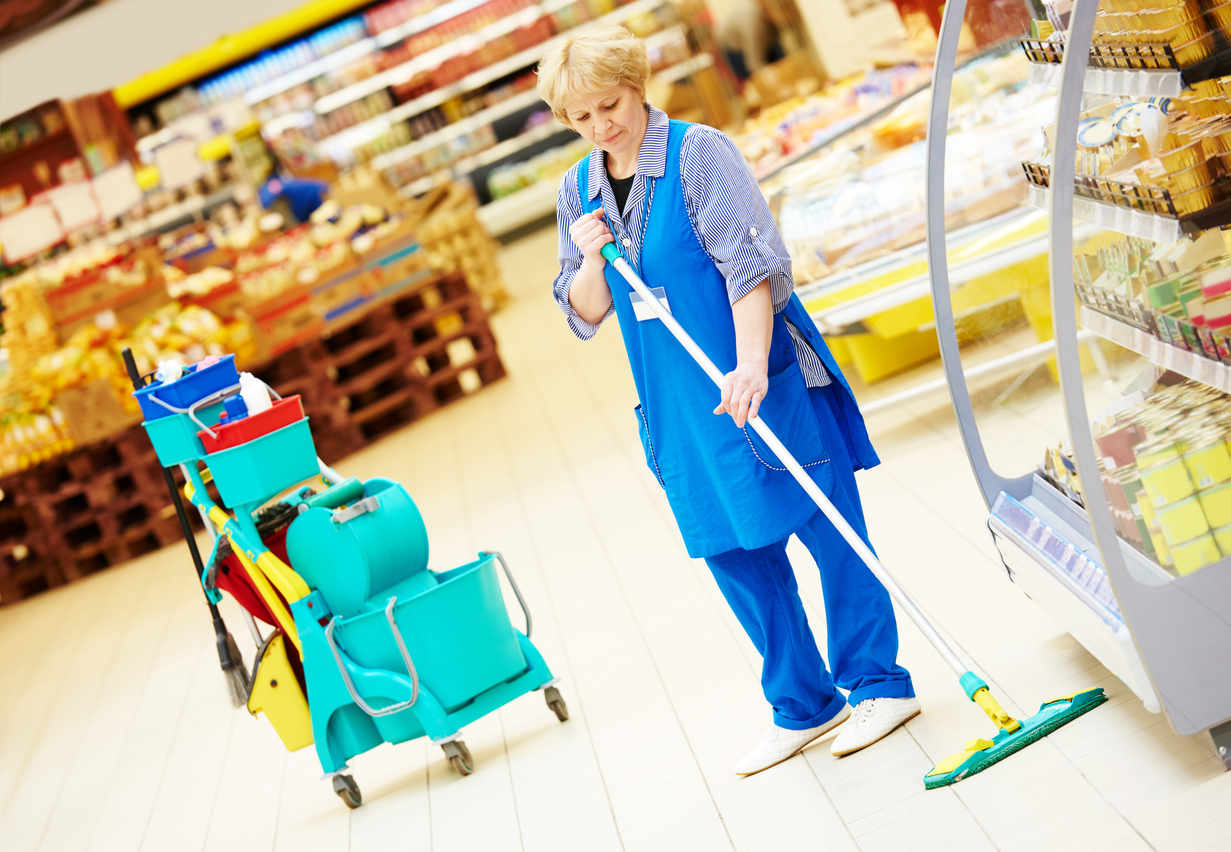
In the modern high-traffic retail landscape, visibility is the new currency of trust. Leading food retailers have realized that hygiene is no longer an "after-hours" back-office task; it is a critical brand signal that must be maintained during peak trading hours.
However, a mounting paradox has emerged: while premium supermarkets prioritize customer-centric, sales-driven activities, their operational backbone remains tethered to labour-intensive legacy cleaning systems. These methods—engineered for a slower, high-vacancy era—are now the primary bottleneck in achieving store-level excellence.
Maintaining floor hygiene in real-time is often deemed "impossible" because traditional methods demand 100% staff dedication. When a spill occurs or high-traffic aisles degrade, retailers face a lose-lose choice:
1. Divert Labor: Pulling skilled staff from shelf replenishment or customer service to operate manual scrubbers.
2. Postpone Hygiene: Waiting until closing to clean, leaving the brand vulnerable to a declining image and safety risks throughout the peak shopping window.
Postponing floor care until after-hours is not a solution; it is a Strategic Leak. Conventional walk-behind scrubbers require significant "non-productive" time—draining tanks, refilling fresh water, and intensive post-use maintenance. This creates three distinct Operational Friction Points:
Every hour a team member spends behind a manual scrubber is a lost hour for Shelf Turnover (Raf Devir Hızı) and FIFO (Stock Rotation). In a low-margin environment, this diversion of labor directly impacts sales throughput.
Traditional scrubbers often sit idle for 90% of the operating day, representing a poor deployment of capital. These assets fail to deliver a return during the hours that matter most—when the customer is actually in the store.
The real issue isn't a staffing shortage or a training gap; it is a system-design flaw. Relying on manual, complex hygiene protocols in a high-speed retail environment quietly undermines customer trust and operational agility.

In a high-velocity retail environment, every minute is a financial metric. When skilled store teams are tethered to manual cleaning equipment, the "Cost of Clean" is far higher than a simple labor hour—it is a direct tax on your Shelf Velocity and Operating Margin. Transitioning to autonomous hygiene protocols removes this operational bottleneck, allowing your team to focus on the four pillars of retail profitability:
The most expensive SKU is the one that remains in the backroom while the shelf sits empty. By automating floor maintenance, retailers recapture the "lost hours" previously spent behind a scrubber. This labor can be redirected to Restocking Velocity, ensuring high-margin items move from the loading dock to the customer’s basket without delay.
Retail success depends on the ability to pivot. Delayed execution of seasonal displays or promotional end-caps results in missed "impulse buy" windows. Automation grants your team the Agility to set up promotional zones on schedule, ensuring that your marketing efforts actually translate into sales floor reality.
Accuracy at the shelf-edge is non-negotiable for customer trust. Manual cleaning often delays critical price-labeling updates and shelf-talker placement. Freeing staff from floor care ensures that Price Integrity remains a priority, reducing checkout friction, minimizing "price-match" disputes, and protecting the brand from regulatory compliance risks.
In food retail, "Time is Quality." When staff are overstretched, meticulous stock rotation (First-In, First-Out) is often the first task to suffer. Autonomous cleaning provides the "Labor Breathing Room" necessary for precise FIFO execution. This directly mitigates shrink, reduces food waste, and ensures that the freshest products are always front-and-center—directly hitting the bottom line.
Glowex prioritizes the true cost of ownership and the total value delivered to its customers. We deliver the future of cleaning, powered by the world’s most trusted and innovative manufacturers.
Driven by Swiss precision and engineering excellence, TASKI (a Solenis brand) has defined the global standard in professional floor care for over 70 years. Today, TASKI blends this legacy of quality with cutting-edge digital and robotic innovations to deliver smarter, more efficient cleaning solutions.
Learn more: Timeline | TASKI About TASKI | TASKI
The TASKI GS Ecobot 50 Pro is the ultimate autonomous scrubbing and drying robot, purpose-built for high-demand environments like retail, healthcare, education, and public spaces. With a high-capacity 30L tank and a theoretical productivity of up to 1,800 m²/h, this robot is designed to optimize efficiency and cover large areas on a single fill.
Sustainability meets performance through its advanced four-stage water recycling system, which filters water down to one micron. This innovative technology reduces chemical usage and eliminates wastewater, significantly lowering your facility’s environmental footprint while extending cleaning coverage.
Unlock the potential of automated floor care with the TASKI Phantas, a compact and highly versatile autonomous cleaning robot designed for smaller facilities. Engineered to excel in areas up to 1,000 m², its sleek dimensions allow it to clean efficiently under tables and in tight, low-clearance spaces that were previously inaccessible to robotic technology.
This all-in-one solution offers multi-application flexibility, operating seamlessly as a scrubber drier, vacuum cleaner, sweeper, or dust mop. Powered by Gausium Robotics, the Phantas features advanced AI-powered obstacle avoidance and a comprehensive sensor array—including LiDAR and 3D depth cameras—to ensure maximum safety in populated environments.
KvK: 92602290
BTW: NL004968846B78
Smaragd 2, 2371LA
Roelofarendsveen, Netherlands
+31645886235
2025 Glowex