Sustainability is one of the most prominent strategies for food retailers today. Supermarkets publicly communicate their resource-management and waste-reduction initiatives, environmental impacts, and long-term targets.
Daily retail cleaning practices significantly impact sustainability efforts and customer perception. Many conventional cleaning products and traditional cleaning methods used today lead to:
Chemical Overdosing: Excessive use of professional cleaning chemicals due to ineffective dilution control increases the risk of chemical residue on surfaces and inflates monthly costs.
Unauthorized Product Use: Unintentional use of retail-ready household cleaning products—outside approved hygiene protocols—that are intended for customer sale, often due to insufficient staff training and oversight.
Inefficient Water Usage: Increased water consumption caused by redundant cleaning and rinsing cycles within overly complex or generic hygiene protocols. Conventional floor cleaning machines often lack the technology to reuse water resulting in wastewater generation.
Plastic Waste: Substantial plastic waste generated by RTU agents and inefficient bulk procurement practices.
Most high-traffic facilities still rely on labor-intensive, conventional cleaning systems that require dedicated staff and long preparation and maintenance times—systems built for a slower era.
Consider a scenario in which a well-known premium supermarket chain is struggling with staff shortages while store teams remain focused on customer-centric activities and sales-driven responsibilities. This is the primary limitation of daytime cleaning—yet daytime cleaning is essential for delivering a strong message to customers.
Periodic floor cleaning during operating hours—even at peak times—keeps stores looking sharp and maintains floor conditions. It sends a clear message to shoppers: hygiene matters everywhere—not just in front-of-house areas, but also in food processing, storage, and preparation zones.
How efficient is it to rely on conventional cleaning methods such as walk-behind scrubbers or manual mopping operated by store personnel?
What are the true operational benefits—and the real return on investment—of walk-behind scrubbers that are primarily used for short cleaning sessions at the end of the day?
1. Extra budget for dedicated cleaning staff
2. Management time spent supervising cleaning
3. Missed cleaning due to staff shortages
4.Repetitive training for new staff
5. Cleaning machinery misuse or damage leading to maintenance and service costs

Labour-intensive manual mopping and walk-behind scrubbers operated by store staff pull them from sales-driving activities:
1. Shelf replenishment
2. Assisting customers
3. Promotional execution
4. Price labeling
5. Stock Rotation-FIFO
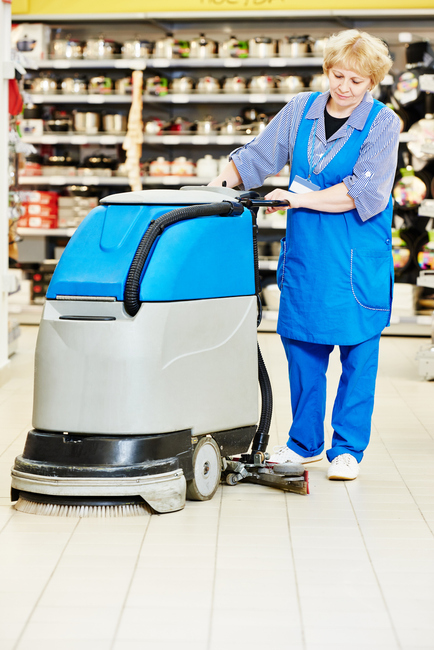
Maintaining floor hygiene and a clean first impression is a major challenge in high-traffic retail stores. With staff focused on intense daily operations and customer service, floor cleaning often falls behind, leaving stores vulnerable to operational inefficiencies and a declining brand image.
Is this a staffing issue? A training gap? The real problem lies deeper—it’s a system-design issue that quietly undermines customer trust across the industry.
Why Daytime Cleaning Fails
Ongoing cleaning during store hours is often impossible because traditional cleaning methods demand full staff dedication. Even spot cleaning of food spills takes longer than necessary, as available staff must be reallocated from other critical tasks.
The Hidden Cost of End-of-Day Cleaning
Many stores postpone floor cleaning until closing time due to the complexity of preparing conventional walk-behind scrubbers—draining dirty water, refilling fresh water, cleaning brushes, and vacuuming the squeegee. By then, floors have already degraded in appearance, leaving a negative impression on customers throughout the day.
The Bottom Line
Outdated cleaning systems not only slow operations—they directly impact the customer experience and brand perception. Retailers need cleaning solutions that match the pace of modern, high-traffic environments to maintain hygiene, operational efficiency, and trust.
Glowex prioritizes the true cost of ownership and the total value delivered to its customers. We achieve this by partnering with one of the world’s most trusted and innovative cleaning machine manufacturers.
For over 70 years, TASKI has set the global standard in professional floor care, driven by Swiss precision and engineering excellence. Today, TASKI blends this legacy of quality with cutting-edge digital and robotic innovations to deliver smarter, more efficient cleaning solutions.
Learn more: Timeline | TASKI About TASKI | TASKI
The TASKI GS Ecobot 50 Pro is the ultimate autonomous scrubbing and drying robot, purpose-built for high-demand environments like retail, healthcare, education, and public spaces. With a high-capacity 30L tank and a theoretical productivity of up to 1,800 m²/h, this robot is designed to optimize efficiency and cover large areas on a single fill.
Sustainability meets performance through its advanced four-stage water recycling system, which filters water down to one micron. This innovative technology reduces chemical usage and eliminates wastewater, significantly lowering your facility’s environmental footprint while extending cleaning coverage.
Unlock the potential of automated floor care with the TASKI Phantas, a compact and highly versatile autonomous cleaning robot designed for smaller facilities. Engineered to excel in areas up to 1,000 m², its sleek dimensions allow it to clean efficiently under tables and in tight, low-clearance spaces that were previously inaccessible to robotic technology.
This all-in-one solution offers multi-application flexibility, operating seamlessly as a scrubber drier, vacuum cleaner, sweeper, or dust mop. Powered by Gausium Robotics, the Phantas features advanced AI-powered obstacle avoidance and a comprehensive sensor array—including LiDAR and 3D depth cameras—to ensure maximum safety in populated environments.
KvK: 92602290
BTW: NL004968846B78
Smaragd 2, 2371LA
Roelofarendsveen, Netherlands
+31645886235
2025 Glowex